
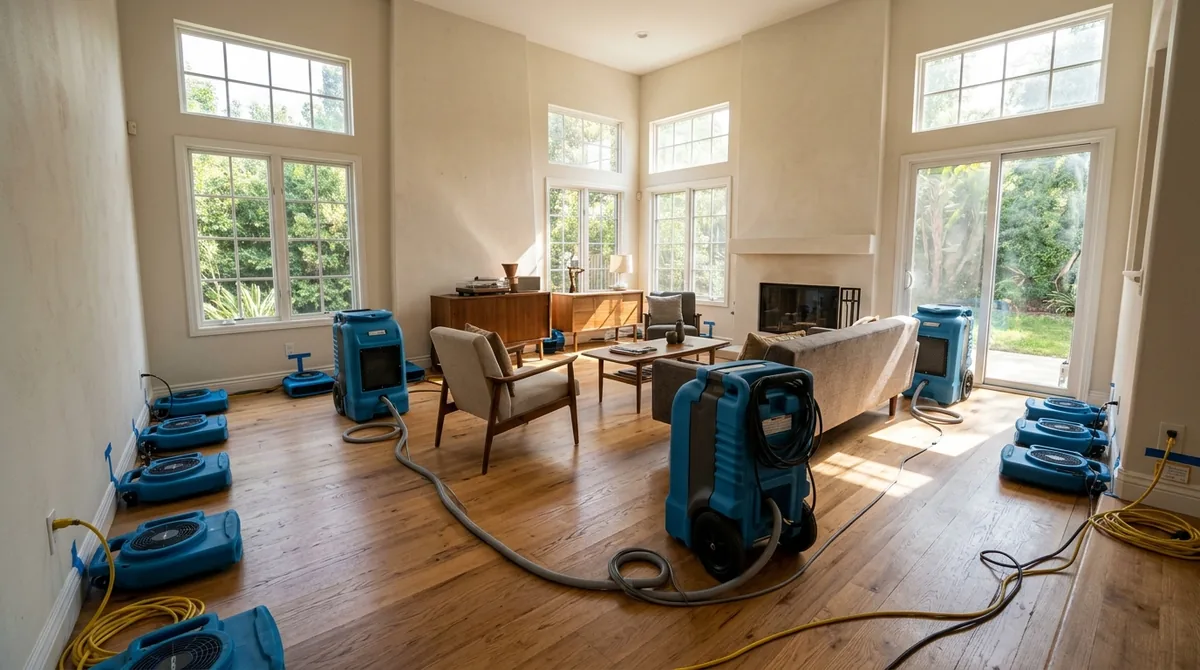
Standard California homeowners policies (HO-3) generally cover sudden and accidental interior water losses—such as a burst supply line, sudden water heater rupture, or unexpected appliance overflow—while typically excluding gradual leaks, neglected maintenance, sewer backups (without an endorsement), and rising exterior floodwater (which requires separate flood insurance).
Sudden & Accidental vs. Gradual Leaks: The Core California Coverage Line
When water pools across a hallway in De Anza or drips through a kitchen ceiling in Rose Ranch, one of the first questions every San Jacinto homeowner asks is whether homeowners insurance will pay for extraction, drying, and repairs. While every policy contract has unique endorsements and exclusions, California adjusters evaluate almost every residential water claim through one foundational distinction: was the water release sudden and accidental, or was it a gradual, repeated seepage over weeks or months?
A braided washing machine hose that bursts overnight, an angle-stop valve that snaps under a bathroom vanity, or a sudden pinhole eruption in a pressurized hot-water line are classic sudden and accidental events. By contrast, a slow drip beneath a kitchen sink that rotted the cabinet floor over six months, deteriorating shower grout allowing water behind tile for years, or a weathered roof valley left unrepaired across multiple winter seasons are routinely denied as long-term maintenance or repeated seepage.
That distinction is one reason fast, well-documented mitigation through our San Jacinto water damage restoration referral line is so valuable: independent local technicians capture Day 1 moisture readings and photographs showing active, recent moisture patterns rather than letting untreated water sit until dark rot looks like neglect.
Quick Reference: Common San Jacinto Water Events & Typical Policy Treatment
| Water Damage Scenario | Typical Standard HO-3 Treatment | Important Policy Detail to Check |
|---|---|---|
| Burst pipe / supply line failure | Often covered (ensuing water damage) | Pipe repair itself is usually excluded; drying & tear-out evaluated |
| Sudden water heater tank rupture | Often covered (water damage to home) | Replacement of the old water heater unit is typically out-of-pocket |
| Slab leak under concrete floor | Ensuing damage & access often evaluated | Check sub-limits for slab access/egress and pipe rerouting |
| Sewer or drain backup into home | Excluded unless Water Backup endorsement added | Verify Water/Sewer Backup rider limit ($5k–$25k common) |
| Rising exterior storm runoff / flood | Excluded under standard HO-3 policy | Requires separate NFIP or private flood insurance policy |
| Slow under-sink or shower-pan drip | Commonly excluded as gradual seepage | California policies scrutinize long-term rot or staining closely |
Should You File a Claim or Pay Out of Pocket? (Deductible Math)
In California's current property insurance environment, filing a claim is a strategic financial decision—not an automatic reflex. Before opening a formal claim number for a localized clean-water spill, take two practical steps: first, review your policy's declarations page to confirm your exact water-damage deductible (commonly $1,000, $2,500, or $5,000 in Riverside County); second, request an on-site moisture inspection and written mitigation estimate from an independent local restoration contractor.
If a localized emergency water extraction and three-day dry-out totals $1,800 and your deductible is $1,500, filing a claim nets only $300 while placing a water-loss record on your CLUE (Comprehensive Loss Underwriting Exchange) report for up to five to seven years. On the other hand, if a second-story supply line or slab leak has soaked multiple rooms, kitchen cabinetry, and hardwood flooring—where mitigation plus rebuild could easily exceed $10,000 to $25,000—filing promptly protects your household finances. You can estimate rough mitigation ranges beforehand with our San Jacinto water damage cost calculator.
Your "Duty to Mitigate" Under California Insurance Contracts
Every standard homeowners policy includes a clause titled Duties After Loss. That clause explicitly requires the homeowner to protect the property from further damage and make reasonable, necessary temporary repairs. In plain English, you do not have to—and should not—leave standing water sitting on your floors for three days waiting for a desk adjuster to return your call.
Starting structural drying and dehumidification right away prevents clean Category 1 water from turning into microbial growth and swollen subfloors. Just make sure you keep complete documentation before any wet drywall or carpet pad is removed so the adjuster can clearly see the original damage footprint.
Exact Documentation Package Adjusters Look For
Clean, organized paperwork speeds up claim review and reduces back-and-forth disputes over line items. Ask your responding independent contractor—and maintain in your own folder—these seven core documents:
- Timestamped Before, During & After Photos: Wide room shots plus close-ups of the failed pipe or appliance, standing water, baseboards, and affected contents.
- Plumber's Cause-of-Loss Invoice: A clear written statement from the licensed plumber describing the sudden failure (e.g., "sudden rupture of braided hot-water supply line under upstairs hall vanity").
- Initial Moisture Map & Thermal Images: Floor-plan sketch showing elevated moisture zones compared against unaffected dry reference walls.
- Daily Psychrometric Drying Logs: Daily readings of indoor temperature, relative humidity, grains per pound (GPP), and wood/drywall moisture percentages until dry standards are met.
- Itemized Equipment Placement List: Exact count and dates for each commercial LGR dehumidifier, air mover, HEPA air scrubber, and containment barrier used.
- Saved Material Samples (If Tear-Out Occurs): Small labeled swatches of removed carpet, pad, or laminate flooring to verify material grade for replacement valuation.
- Separate Mitigation vs. Rebuild Estimates: Keeping emergency dry-out invoicing distinct from post-drying drywall, flooring, and paint reconstruction makes adjuster review much smoother.
Understanding Special Riders for San Jacinto Homes
San Jacinto neighborhoods span a wide range of construction eras—from 1950s–1980s homes in Heritage and Park Hill to newer single-family tracts in Spice Ranch and Greens of San Jacinto. When reviewing your policy during renewal season, pay special attention to three endorsements:
- Water Backup & Sump Overflow Endorsement: Crucial for older homes with mature trees near main sewer laterals where root intrusion can trigger sudden sewage backup cleanup needs.
- Ordinance or Law Coverage: Helps cover added code-upgrade costs if a major rebuild triggers current California building code or City of San Jacinto Building & Safety Division permit requirements.
- Additional Living Expenses (ALE / Loss of Use): Covers temporary hotel or rental costs if widespread ceiling and drywall repair or Category 3 remediation makes your home temporarily uninhabitable.
How Mitigation Billing & Adjuster Walkthroughs Work in Riverside County
Once emergency extraction and drying equipment are operating in your home, your insurance carrier will assign a desk adjuster or send a field adjuster to inspect the affected rooms in San Jacinto. Most experienced independent water restoration contractors prepare line-item estimates using standardized restoration pricing software (such as Xactimate) that breaks down extraction square footage, daily LGR dehumidifier and air mover counts, antimicrobial application, and drywall or carpet pad tear-out using regional Riverside County labor rates.
Ask your contractor to walk you through the written scope before sending anything to your carrier, and request copies of every moisture log and invoice submitted on your behalf. Keep a dedicated email thread with your adjuster so approvals for supplemental work—such as discovering hidden wet insulation behind kitchen cabinets or subfloor damage under a slab leak—stay documented in writing from start to finish.
What to Ask a Restoration Contractor Before Signing a Work Authorization
Because Ramona Valley Water Damage Restoration is a free local referral service, you contract directly with the independent local restoration provider who arrives at your property. Before signing any work authorization or Assignment of Benefits style agreement, ask four straightforward questions: (1) Are you actively licensed and insured in California for the scope being performed? (2) Do you provide an itemized scope and daily moisture logs formatted clearly for insurance adjusters? (3) How do you handle billing if my insurer approves only part of the estimate? (4) What is my out-of-pocket responsibility if I choose not to file a claim?
Taking ten minutes to review these details protects both your home and your wallet. For immediate emergency steps while you check your policy, follow our first 24 hours water damage checklist or call our 24/7 San Jacinto referral line at (951) 555-0194 to connect with an independent local specialist.
Frequently Asked Questions
Many California policies cap mold remediation at a sub-limit (often $5,000 to $10,000) or exclude mold unless it directly resulted from a covered sudden and accidental water loss and the homeowner took prompt steps to mitigate moisture.
Yes. Under California insurance principles, homeowners generally have the right to choose their own licensed restoration contractor rather than being forced to use an insurer's preferred vendor list, though you should confirm pricing transparency and Xactimate-style documentation.
It can. Because California's property insurance market has tightened significantly, many homeowners compare the written mitigation estimate against their deductible before deciding whether to file a claim for minor losses.
Need an Independent Local Crew in San Jacinto?
Call (951) 555-0194 any time to connect with an independent water mitigation specialist serving San Jacinto, CA.