
Under IICRC S500 restoration standards, Water Damage Categories (1, 2, and 3) classify the level of contamination from clean supply water to hazardous black water, while Drying Classes (1, 2, 3, and 4) measure the amount of absorbed moisture and evaporation difficulty across floors, drywall, and structural framing.
Why Do Restoration Technicians Classify Every Loss Before Setting Up Equipment?
When an independent restoration technician inspects a wet room in San Jacinto, you will often hear them refer to terms like "Category 2, Class 2" or "Category 3 flood cut." Those labels are not arbitrary industry jargon—they come from the ANSI/IICRC S500 Standard for Professional Water Damage Restoration, the technical reference framework used across the restoration and insurance industries.
Accurate classification directly governs three practical decisions in your home: (1) which materials can be safely dried in place versus which porous items must be removed for health reasons, (2) how many commercial air movers and LGR dehumidifiers are required to reach dry standards without over-drying or under-drying, and (3) how your insurance adjuster evaluates the scope of mitigation. Understanding these two scales empowers San Jacinto homeowners to ask informed questions when hiring an independent crew through our San Jacinto water damage restoration referral line.
The 3 Water Damage Categories (Contamination Level)
Water categories describe the sanitary condition of the water at the time of loss—and remember that water category can worsen if mitigation is delayed.
Category 1: Clean Water
Category 1 water originates from a sanitary source and does not pose substantial immediate harm from dermal contact or incidental exposure. Common San Jacinto examples include a ruptured braided supply line behind a bathroom sink in Rose Ranch, a leaking copper pipe beneath a slab in Spice Ranch, an overflowing clean bathtub, or a ruptured residential water heater tank.
When addressed promptly with emergency water extraction and commercial dehumidification, Category 1 losses offer the highest salvageability. Intact carpet, wood framing, and lightly dampened drywall can frequently be dried in place—saving homeowners significant reconstruction expense. However, if clean water sits stagnant for more than 48 hours or passes through dusty wall insulation and subfloor debris, technicians may upgrade the loss to Category 2.
Category 2: Gray Water
Category 2 water contains significant contamination and carries the potential to cause discomfort or sickness if ingested or contacted. Typical residential sources include washing machine discharge overflows, dishwasher drain leaks, sump pump failures, toilet bowl overflows containing urine (without solid waste), and clogged HVAC condensate drain pans dripping through attic drywall.
Because gray water introduces detergents, organic residues, and microorganisms into porous fibers, carpet padding soaked by Category 2 water is normally removed and discarded, while the carpet itself may be evaluated for thorough antimicrobial cleaning or replacement. Hard surfaces and framing require cleaning and EPA-registered antimicrobial application before structural drying and dehumidification begins.
Category 3: Black Water (Grossly Unsanitary)
Category 3 water is grossly contaminated and can contain pathogenic bacteria, viruses, fungi, and chemical toxins. In San Jacinto, Category 3 losses most commonly stem from main sewer lateral backups into ground-floor showers or toilets, septic backups, or exterior winter storm runoff that flowed across soil, driveways, or street gutters before entering a garage or living room near Park Hill or Greens of San Jacinto.
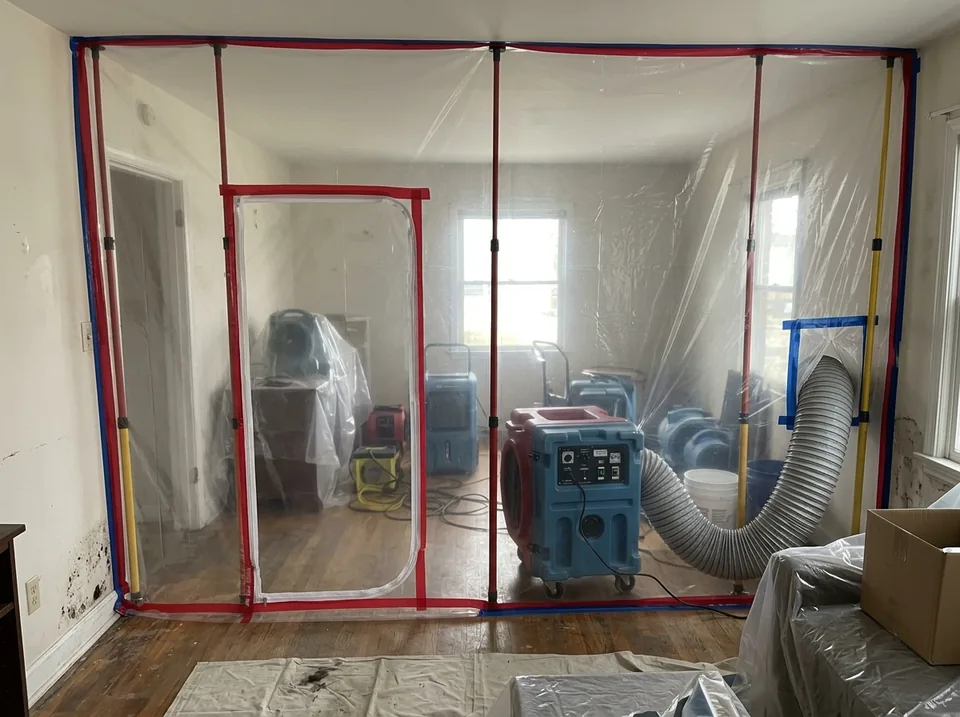
Category 3 mitigation requires strict containment protocols: technicians isolate the work zone with polyethylene zip-wall barriers, deploy HEPA negative air scrubbers, wear full personal protective equipment (PPE), remove and bag all saturated porous materials (carpet, pad, swollen baseboards, insulation, and lower drywall flood cuts), and thoroughly sanitize structural framing before drying. Explore our sewage backup cleanup and flood and storm water cleanup pages for detailed protocol breakdowns.
| Category | Typical San Jacinto Sources | Carpet & Pad Salvage | Containment & Sanitizing |
|---|---|---|---|
| Category 1 (Clean) | Supply lines, water heater, clean tub overflow | Carpet often salvageable; pad evaluated | Standard extraction & monitored drying |
| Category 2 (Gray) | Washer/dishwasher drain, AC condensate pan | Pad removed; carpet cleaned or replaced | Surface cleaning + antimicrobial treatment |
| Category 3 (Black) | Sewer backup, toilet solids, exterior storm runoff | Carpet, pad & porous drywall removed | Full poly containment, HEPA air scrubber & disinfection |
The 4 Water Damage Drying Classes (Evaporation Load)
While Category tells technicians how dirty the water is, Class tells them how much water has been absorbed by building materials and how fast it can be evaporated.
Class 1: Slow Evaporation Rate (Least Water)
Class 1 losses affect only part of a single room, or a larger area with low-porosity materials such as concrete or ceramic tile, where little or no wet carpet pad or drywall wicking occurred. Moisture absorption is minimal, so a compact equipment setup often achieves dry standards in 2 to 3 days.
Class 2: Fast Evaporation Rate (Moderate Absorption)
Class 2 is the most common residential scenario in San Jacinto—for example, a laundry room supply leak that floods an entire bedroom and hallway, saturating carpet, cushion pad, and wicking up the bottom 12 to 24 inches of drywall. Technicians calculate airflow and LGR dehumidifier capacity to evaporate large volumes of free water rapidly before secondary humidity spreads into adjacent closets.
Class 3: Fastest Evaporation Rate (Overhead Saturation)
Class 3 losses typically involve water coming from overhead—such as an upstairs bathroom pipe burst in De Anza, an attic HVAC pan failure, or a roof leak during a winter storm. Ceilings, wall cavities, insulation, carpet, and subfloors are all wet simultaneously. Achieving proper airflow often requires controlled ceiling and drywall water damage repair openings and wet insulation removal so overhead joists can breathe.
Class 4: Specialty Drying Situations (Bound Water)
Class 4 applies to dense, low-permeance materials that hold deeply bound moisture—such as solid hardwood flooring, dense concrete slabs, plaster, brick, or subfloor framing trapped under multiple layers. Standard surface fans alone cannot pull bound moisture out of hardwood planks; technicians rely on low-grain refrigerant or desiccant dehumidification, specialized floor drying mats, and extended psychrometric monitoring.
Comparison of Drying Classes & Typical Equipment Needs
| Drying Class | Affected Materials | Typical Drying Duration | Primary Equipment Approach |
|---|---|---|---|
| Class 1 | Partial room, mostly tile or bare concrete | 2–3 days | Targeted extraction + 1 LGR dehumidifier & minimal air movers |
| Class 2 | Full room carpet/pad + lower 12–24" drywall | 3–5 days | Weighted extraction + perimeter air movers + sized LGR unit(s) |
| Class 3 | Ceilings, walls, attic insulation & floors | 4–6 days | Flood/ceiling cuts, wet insulation removal + high-capacity LGR |
| Class 4 | Hardwood, dense concrete, plaster, deep framing | 5–7+ days | Specialty floor/cavity drying mats + low-grain/desiccant drying |
How Do Category and Class Affect San Jacinto Mitigation Costs?
Both scales directly influence labor, safety gear, tear-out volume, and equipment days. A Category 1, Class 1 localized clean-water spill requires far fewer labor hours and disposal fees than a Category 3, Class 3 sewage or storm-flooded ceiling and wall cavity. You can test how Category and Class multipliers change estimated ranges right now using our interactive San Jacinto water damage cost calculator.
When an independent technician visits your home in Heritage, Rose Ranch, or Park Hill, ask them to state both the Category and Class on your written inspection sheet and show you the daily moisture-meter readings so you can see progress clearly from Day 1 through final dry verification. Need immediate on-site assessment? Call (951) 555-0194 24/7.
Frequently Asked Questions
Yes. Even clean water from a burst supply pipe degrades over time as it dissolves dirt, carpet adhesives, and organic dust inside wall cavities. Left standing for 48 hours or longer—especially in warm San Jacinto indoor temperatures—Category 1 water can escalate into Category 2 or Category 3 contamination.
Category (1, 2, or 3) measures how contaminated the water is and determines health, sanitizing, and material disposal rules. Class (1, 2, 3, or 4) measures how much water absorbed into building materials and how difficult evaporation will be, which determines equipment sizing and drying time.
Class 4 losses involve low-porosity, bound-water materials such as hardwood flooring, plaster, brick, or concrete slabs. Pulling deep moisture out of dense materials requires specialized low-grain dehumidifiers, heat/airflow control, and longer monitoring cycles.
Need an Independent Local Crew in San Jacinto?
Call (951) 555-0194 any time to connect with an independent water mitigation specialist serving San Jacinto, CA.